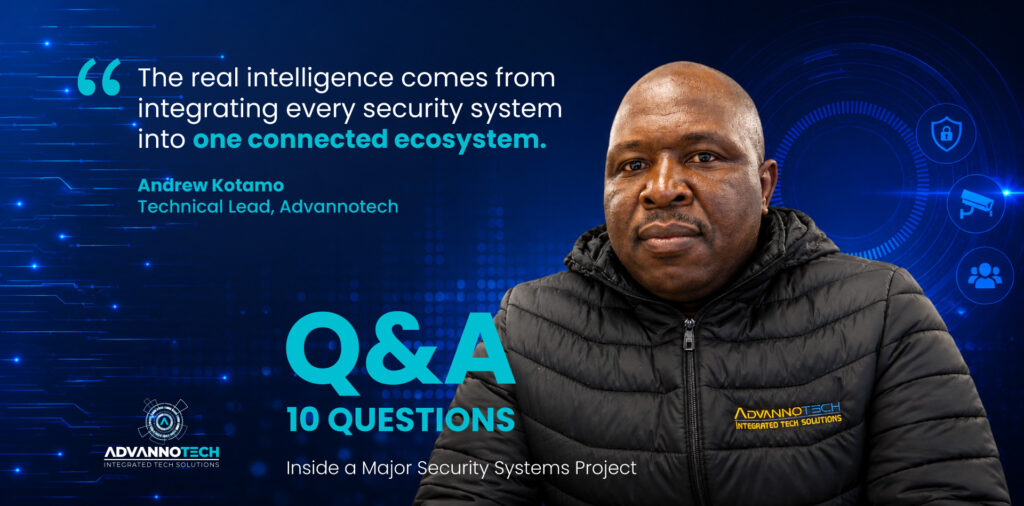
10 Questions Q&A: Inside a Major Security Systems Project
How a Security System Lead Technician Is Driving Smarter, Safer, and More Connected Facilities
For years, security infrastructure in commercial and industrial environments has often been managed through disconnected systems, reactive maintenance, and limited operational visibility. CCTV systems operated independently from access control. Alarm systems lacked centralised monitoring. Fault reporting was delayed. Maintenance was reactive instead of preventative.
As buildings, campuses, and facilities continue to evolve into smarter environments, security systems also need to become more intelligent, integrated, and proactive.
This modern security systems project was designed to address those challenges.
Powered by advanced CCTV surveillance, intelligent access control, network infrastructure, intrusion detection, centralised monitoring, and remote management capabilities, the solution creates a connected security ecosystem that improves visibility, strengthens response times, enhances operational control, and supports future-ready infrastructure.
To better understand the operational realities behind the deployment, we spoke to the Security System Lead Technician, Andrew Kotamo who was responsible for overseeing implementation, commissioning, troubleshooting, integration, and technical delivery across the project.
Here are his answers in this edition of 10 Questions Q&A.
1. Many organisations still rely on outdated or disconnected security systems. What operational challenges were you seeing before implementing this integrated security solution, and why was change necessary?
A: Before the implementation, many of the systems were operating independently. CCTV, access control, alarms, and network infrastructure were not fully integrated, which made monitoring and incident response slower and less effective. In some areas, faults were only discovered after incidents occurred, and reporting was largely manual.
This created challenges for security teams because visibility across the site was limited, troubleshooting took longer, and there was no centralised way to manage or monitor the environment effectively. The client needed a more modern, integrated, and scalable solution that could improve security operations, system reliability, and overall situational awareness.
2. One of the biggest frustrations in large facilities is delayed incident response and limited visibility. How does an integrated security system improve operational efficiency for both security teams and management?
A: An integrated security system allows operators to monitor multiple technologies from a centralised platform. CCTV footage, access control events, alarms, and system health information can all be viewed together in near real time.
For security teams, this improves response times because incidents can be verified immediately through live monitoring and recorded footage. For management, it creates better accountability, clearer reporting, and improved visibility into site operations. Instead of relying on fragmented systems, the client now has a connected environment where information is available quickly and accurately.
3. Visibility is often a major issue when managing large sites, campuses, or multi-building facilities. How does your solution create a clearer operational picture across the environment?
A: The solution provides centralised monitoring across all connected systems and devices. Cameras, access control points, alarm systems, and network infrastructure can all be monitored from a single platform.
This gives the client a clearer understanding of what is happening across the facility at any given time. Security teams can track movement, monitor restricted areas, identify faults, and respond to incidents much faster. It also improves coordination between security personnel, facilities management, and technical support teams.
4. Security risks and system faults can become serious operational problems if they are not detected early. How does real-time monitoring help reduce these risks?
A: Real-time monitoring allows issues to be identified immediately instead of waiting for manual inspections or incident reports. For example, if a camera goes offline, an access control device loses communication, or an alarm is triggered unexpectedly, the system can notify operators instantly.
This allows the technical team to investigate and resolve issues before they escalate into larger operational or security risks. Faster detection leads to faster response times, reduced downtime, and improved overall reliability of the security infrastructure.
5. Modern security systems involve far more than just installing cameras. Can you explain how networking, software integration, and centralised monitoring work together to create an intelligent security ecosystem?
A: The camera or access control device is only one part of the solution. The real intelligence comes from integrating all the systems together through the network infrastructure and centralized software platforms.
The devices communicate across the network and send information into the monitoring platform where operators can view events, alarms, footage, reports, and system health data. This creates a connected ecosystem where security operations become proactive instead of reactive. The integration also improves reporting, analytics, troubleshooting, and future scalability.
6. Facilities and security managers are under pressure to improve safety while reducing operational inefficiencies. How does automation help achieve this?
A: Automation reduces the amount of manual monitoring and repetitive operational tasks. Events such as unauthorised access attempts, device failures, or alarm activations can trigger automatic alerts, recording actions, or notifications.
This allows security personnel to focus on high-priority incidents instead of constantly checking systems manually. Automated reporting, centralised monitoring, and remote diagnostics also reduce administrative workload while improving overall operational efficiency.
7. Many organizations struggle with multiple vendors and disconnected technologies. What are the advantages of having a centralised security platform?
A: A centralised platform gives the client one trusted environment for monitoring and managing security operations. CCTV, access control, alarms, intercom systems, and network devices can all be managed together instead of separately.
This simplifies operations, improves visibility, and reduces the complexity of managing multiple systems independently. It also improves accountability because all events, reports, and operational data are available in one place.
From a technical perspective, centralised systems also create a strong foundation for future integrations, analytics, reporting, and expansion.
8. Businesses are increasingly focused on operational intelligence and risk management. How can security data support smarter decision-making while improving overall business operations?
A: Security data provides valuable insight into how facilities operate. Access control trends, incident reports, camera analytics, and operational activity can help management identify risks, improve processes, and strengthen overall security planning.
The same data can also support operational improvements by helping facilities teams understand traffic flow, restricted area activity, system performance, and potential vulnerabilities. This allows businesses to make more informed decisions while improving both security and operational efficiency.
9. Scalability is often overlooked during infrastructure deployments. Why is it important for security systems to be future-ready, and what opportunities does this create?
A: Scalability is critical because operational requirements change over time. Facilities expand, technologies evolve, and security risks become more advanced. A future-ready system allows the client to add more cameras, access control points, analytics, buildings, and integrations without replacing the entire infrastructure.
It also creates opportunities for advanced features such as AI analytics, remote monitoring, facial recognition, perimeter detection, smart reporting, and integration into broader building management systems.
10. Looking ahead, how do you see intelligent security systems reshaping commercial buildings, industrial facilities, campuses, and smart cities over the next few years, and what role will data play in that transformation?
A: Security systems are moving beyond traditional surveillance and becoming part of the broader digital infrastructure of modern facilities. The future is centralised monitoring, intelligent analytics, automated alerts, remote accessibility, and data-driven operations.
In commercial buildings, industrial facilities, campuses, and smart cities, security infrastructure will continue to integrate with operations, facilities management, and smart technologies. Data will play a major role by helping organisations improve safety, reduce risk, optimize operations, and make smarter long-term decisions.
The role of the Security System Lead Technician is to bring all the technical layers together — cameras, access control, networking, software platforms, monitoring systems, integrations, and operational workflows — into one reliable and fully functional solution.
Advannotech’s Commitment to Long-Term Security Partnerships
At Advannotech, the relationship with clients extends far beyond the initial installation phase. One of the key reasons customers continue to work with Advannotech is the company’s strong focus on after-sales support, maintenance services, and rapid technical response.
Through a dedicated help desk and technical support structure, clients benefit from quick response times, efficient fault resolution, and ongoing system reliability. This level of support is especially critical in environments where security systems play a vital operational role and downtime must be minimised.
Advannotech also proudly maintains Service Level Agreements (SLAs) with various retail shopping centres and commercial facilities across multiple provinces in South Africa. These long-term partnerships reflect the company’s commitment to service excellence, operational consistency, and trusted client relationships.
From preventative maintenance and technical support to large-scale system rollouts and infrastructure upgrades, Advannotech continues to position itself as a reliable technology partner for modern security and smart utilities.
Contact us: info@advannotech.co.za