10 Questions Q&A: What It Takes to Deliver a Nationwide IoT Inspection Programme
When people think about large-scale technology deployments, they often picture the installation teams, the equipment, and the finished solution. What they don’t always see is the planning, coordination, reporting, and problem-solving that happens long before the first device is installed.
Behind every successful national rollout is a team responsible for keeping hundreds of moving parts aligned. Site access must be secured. Teams need to be coordinated. Risks must be identified and escalated. Reporting needs to be accurate. Timelines have to be maintained. And all of this must happen while balancing the expectations of clients, vendors, technicians, and project stakeholders.
For Lunga Myeza, Project Coordinator at Advannotech, this is where she thrives.
With experience spanning project coordination, stakeholder engagement, business development, and national operational rollouts, Lunga recently played a key role in managing a nationwide inspection programme covering 360 sites in just one month. The project involved assessing utility infrastructure, connectivity, power availability, compliance requirements, environmental conditions, and site readiness ahead of a major smart utilities deployment.
The scale was significant. The timelines were demanding. The margin for error was small.
In this edition of our 10 Questions Q&A series, we sat down with Lunga to discuss her career journey, what it takes to coordinate high-pressure multi-site projects, the lessons learned from national rollouts, and how accurate planning and inspections lay the foundation for successful technology deployments.
From communication and accountability to planning and execution, her insights offer a fascinating behind-the-scenes look at what it takes to deliver complex projects at scale.
1. Your career journey spans project coordination, stakeholder engagement, national rollouts, and business development. What initially drew you to project coordination and large-scale operational work?
A: What drew me to project coordination was the opportunity to bring structure to complex work. I have always enjoyed environments where there are many moving parts, different stakeholders, strict timelines, and real operational pressure. Project coordination allows me to sit at the centre of planning, communication, follow-ups, reporting, and execution.
My background in business development also helped shape this interest because it taught me how important client communication, responsiveness, and accountability are. Over time, I realised that I enjoy not only supporting projects, but helping teams move from planning to actual delivery. That is what attracted me to large-scale operational work: the ability to contribute to projects that have visible outcomes across multiple sites, regions, and stakeholders.
2. You’ve worked on multiple national projects across South Africa, including infrastructure and technology rollouts. What lessons from those experiences prepared you for a project of this scale?
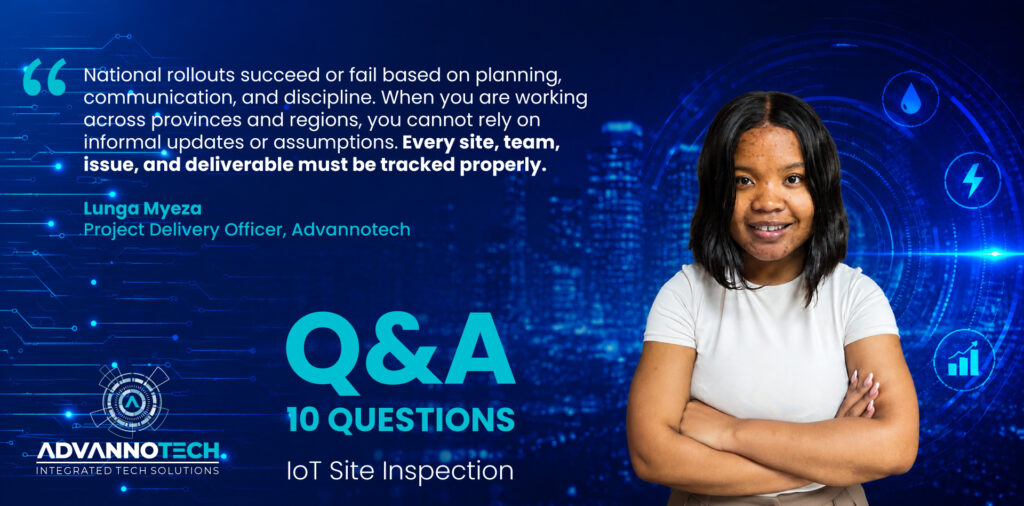
A: The biggest lesson is that national rollouts succeed or fail based on planning, communication, and discipline. When you are working across provinces and regions, you cannot rely on informal updates or assumptions. Every site, team, issue, and deliverable must be tracked properly.
3. People often see project success, but not the coordination behind the scenes. What does a typical day look like for you when managing high-pressure, multi-site operations?
A: A typical day starts with checking the project schedule, site plans, technician movements, outstanding actions, and priority risks. From there, I follow up with teams on the ground, confirm site access, monitor progress, update trackers, and make sure information is flowing between the client, project managers, vendors, and internal teams.
A big part of the day is communication. I need to know which sites are completed, which ones are delayed, what issues were found, and what support the field teams need. I also focus heavily on documentation because in a high-pressure rollout, accurate records are critical. This includes inspection reports, risk registers, milestone updates, incident logs, and action items.
Behind the scenes, the work is about keeping control of the moving parts. If there is a delay, access issue, missing information, or technical concern, it must be identified early, escalated properly, and closed out quickly.
The Project: 360 Sites in One Month
4. When you first joined this rollout project, what was the scale of the challenge, and what stood out to you immediately?
A: The scale was significant from the start. Coordinating inspections across 360 sites in one month meant that there was very little room for poor planning, unclear communication, or delayed reporting. What stood out immediately was the speed required, but also the level of detail needed at every site.
What stood out to me most was that the project needed both speed and accuracy. Completing many sites quickly is one thing, but completing them with reliable data, proper evidence, and consistent reporting is what makes the work valuable.
5. Coordinating inspections across 360 sites nationwide within a month is a massive operational undertaking. What systems, planning methods, or processes helped keep everything on track?
A: The most important tools were structured planning, centralised tracking, clear communication channels, and disciplined reporting. We had to work with site schedules, inspection trackers, team allocations, progress updates, and escalation processes to make sure nothing was missed.
6. The inspections covered technical infrastructure, utility meters, power availability, connectivity, compliance, and environmental conditions. Why is this inspection phase so critical before installations begin?
A: The inspection phase is critical because it reduces uncertainty before installation begins. It confirms what is actually available and required on site, rather than relying only on assumptions or old information.
For smart utility installations, the team needs to know whether the site has suitable utility meters, reliable power, space for equipment, connectivity options, compliance constraints, and any environmental risks that may affect installation. If these items are not checked upfront, the installation phase can face delays, rework, incorrect equipment allocation, or unexpected costs.
7. National projects inevitably come with obstacles (from scheduling and site access to communication and reporting). What were some of the biggest challenges faced, and how did you solve them?
A: Some of the biggest challenges were site access, scheduling changes, inconsistent information, and the speed at which reports had to be submitted and reviewed. In a national rollout, a small delay at one site can quickly affect the broader programme if it is not managed properly.
The way to solve this was through proactive coordination. We had to confirm access arrangements early, follow up continuously with site contacts, keep field teams updated, and escalate blockers before they became major delays. Communication had to be clear and frequent, especially between the project team, technicians, vendors, and client stakeholders.
8. One of the biggest risks in large rollouts is inconsistency across sites and teams. How did you ensure reporting accuracy and inspection quality at such a high volume and speed?
A: The key was standardising the inspection process. When teams are working across different regions, they need clear templates, defined information requirements, and consistent reporting expectations. This helps reduce interpretation differences between teams.
I also believe in regular follow-ups and quality checks. It is not enough to wait until the end of the week to review information. Reports must be checked continuously so that missing details, unclear findings, or incomplete evidence can be corrected while the site visit is still fresh.
Good coordination also depends on accountability. Every team must know what information is required, when it must be submitted, and who is responsible for resolving gaps. That is how you maintain quality even when the project is moving at speed.
9. What impact does completing accurate inspections upfront have on the success of the actual smart utility installations and long-term client outcomes?
A: Accurate inspections create a strong foundation for successful installations. They help the project team understand each site properly, allocate the correct equipment, plan the right technical approach, and reduce the risk of installation delays.
For the client, this means fewer surprises during implementation, better budget control, and a smoother rollout. It also improves long-term outcomes because the installed solution is based on real site conditions, not assumptions.
10. Looking back at successfully completing 360 inspections in just one month, what are you most proud of; both professionally and personally? And looking forward, what’s next for the bigger project?
A: Professionally, I am proud of being part of a team that delivered a high-volume, national inspection programme within a demanding timeline. Completing 360 inspections in one month required discipline, coordination, communication, and teamwork. It showed that with the right structure and commitment, large-scale rollouts can be managed effectively.
Personally, I am proud of the growth that comes from working under pressure. Projects like this test your ability to stay organised, communicate clearly, solve problems quickly, and remain accountable even when the pace is intense.
Looking forward, the next step is to use the inspection outcomes to support the actual smart utility installation phase. The information gathered now will help the project team plan installations properly, manage risks, allocate resources, and deliver a solution that creates long-term value for the client.
What becomes clear from speaking with Lunga is that successful projects are rarely the result of technology alone. They are built on careful planning, disciplined execution, clear communication, and the people who keep everything moving forward.
The successful completion of 360 site inspections in a single month demonstrates the importance of strong project coordination in large-scale rollouts. By ensuring accurate information is gathered upfront, risks are identified early, and stakeholders remain aligned, the project team has created a solid foundation for the next phase of the smart utilities deployment.
For Lunga, the achievement represents more than a completed milestone. It reflects the value of teamwork, accountability, and maintaining focus under pressure. It also highlights the growing role project coordination plays in delivering complex infrastructure and technology programmes across South Africa.
As the project moves into the installation phase, the work completed during the inspections will continue to guide decision-making, resource allocation, and implementation planning — ensuring the client receives a solution built on accurate data and real-world site conditions.
For Advannotech, it is another example of how successful technology projects begin long before installation day. They begin with the people, processes, and planning that make large-scale delivery possible.
Contact us: info@advannotech.co.za