10 Questions Q&A: Inside a Major African ICT Company’s Smart Utilities Project
For years, utility management in commercial buildings has largely remained stuck in the past. Manual meter readings. Spreadsheet-based billing. Limited visibility into shared infrastructure. Delayed reporting. Reactive maintenance.
While buildings themselves have become more advanced, the systems managing electricity and water consumption often haven’t kept pace. And in large, multi-tenant environments, that gap can quickly translate into operational inefficiencies, inaccurate billing, unnecessary wastage, and frustrated stakeholders.
This Smart Utilities project for a large African ICT company was designed to change that.
Powered by NB-IoT connectivity, intelligent metering, and cloud-based monitoring, the solution brings together electricity, water, billing, reporting, and operational visibility into a single connected ecosystem. The result is smarter utility management, improved transparency, faster decision-making, and a stronger foundation for future-ready commercial infrastructure.
To unpack the real challenges behind the project and the thinking that shaped the solution, we spoke to Steffen Engelbrecht, Projects & Delivery Manager for Advannotech.
From reducing manual administration and improving tenant accountability to enabling near-real-time visibility into building consumption, Steffen shares valuable insight into how intelligent utility management is reshaping the future of facilities operations.
Here are his answers on the project in our first edition of 10 Questions Q&A.
Many organisations still rely on manual utility readings and fragmented systems. What operational challenges were you seeing before implementing this smart utilities solution, and why was change necessary?
A: Before the implementation, the client relied on manual readings which meant someone physically had to go to each meter, record the reading, and then process that information afterwards. In a commercial property environment with multiple tenants, this creates delays, admin pressure, and the risk of incorrect readings. Tariffs were also being managed manually, which added another layer of possible human error. Change was necessary because the property owner needed a more accurate, automated, and transparent way to manage utility consumption, billing, and tenant accountability.
One of the biggest frustrations in multi-tenant or large commercial environments is inaccurate or delayed utility billing. How does smart metering solve this problem, and what impact does that have on both operations teams and tenants?
A: Smart metering removes the dependency on manual reading cycles. With the client’s business utilities, readings are collected automatically from the meters and made available on the platform. This allows the client to view consumption and billing information in real time or near real time. For operations teams, it reduces manual admin, improves accuracy, and provides a clear audit trail. For tenants, it creates more confidence because billing is based on actual measured consumption, not delayed readings, estimates, or manually captured spreadsheets.
Visibility is often a major issue when it comes to shared infrastructure like HVAC systems, chillers, and common-area utilities. How does your solution create a clearer, more transparent picture of consumption across a facility?
A: The solution gives the property owner a central view of utility consumption across the building. Each tenant still has a main meter, which provides a clear view of tenant-level electricity and water usage. In addition to that, HVAC consumption is measured separately, allowing the client to see how much energy is being used by major shared building systems.
This is important because HVAC and common-area infrastructure can be significant cost drivers in commercial properties. By separating tenant consumption from shared services, the owner can better understand usage patterns, allocate costs more fairly, and identify areas where operational efficiency can be improved. It also gives facilities teams better visibility into whether HVAC systems are operating within expected usage patterns or consuming more than they should.
Water and energy wastage can quietly become massive cost drivers. How does real-time monitoring help organisations identify inefficiencies, leaks, or abnormal usage before they become expensive problems?
A: Near-real-time monitoring makes abnormal usage visible much earlier. For example, if a water meter continues running after hours, it may point to a leak or uncontrolled usage. If electricity consumption spikes outside normal operating patterns, it may indicate equipment being left on, incorrect scheduling, or inefficient usage. Instead of waiting for the monthly bill to expose the problem, the client can investigate while the issue is still active. That is where the real value sits: faster detection, faster response, and less wastage.
Smart utilities are about far more than just “reading meters.” Can you explain how NB-IoT connectivity and cloud-based monitoring work together to create a truly intelligent utilities ecosystem?
The meter is only one part of the solution. The real intelligence comes from connecting the meter, transmitting the data reliably, and making that data useful. NB-IoT is well suited for utility environments because meters are often located in basements, plant rooms, risers, or areas where normal connectivity is not always reliable. The meter sends its readings through the NB-IoT network into the cloud platform, where the data can be viewed, validated, reported, and used for billing. This turns the utility infrastructure into a connected ecosystem instead of a manual monthly process.
Facilities managers are under growing pressure to do more with less. How does automation reduce administrative workload and improve operational efficiency for teams managing large properties or campuses?
Automation removes a large portion of repetitive manual work. The facilities team no longer needs to rely on physical readings, manual spreadsheet updates, and manual tariff calculations. Readings, usage trends, and billing information can be accessed directly from Telkom Business Utilities. Custom tariffs, municipal tariffs, and Time-of-Use tariffs can also be configured digitally. This reduces admin workload and gives the team more time to focus on exceptions, tenant queries, maintenance issues, and operational improvements.
Many organisations struggle with siloed utility data spread across different systems and suppliers. What are the benefits of having a single, centralised platform for electricity and water monitoring?
A centralized platform gives the client one trusted view of utility data. Electricity, water, sanitation-related monitoring, tariffs, readings, and billing information can be managed in one place. This reduces the need to compare different spreadsheets, supplier reports, and manual records. It also improves accountability because the owner, operations team, and tenants can all work from the same data. From a technical perspective, this also creates a strong foundation for reporting, integrations, analytics, and future expansion.
Businesses are increasingly focused on sustainability and resource optimisation. How can smart utility data support better environmental decision-making while also improving financial performance?
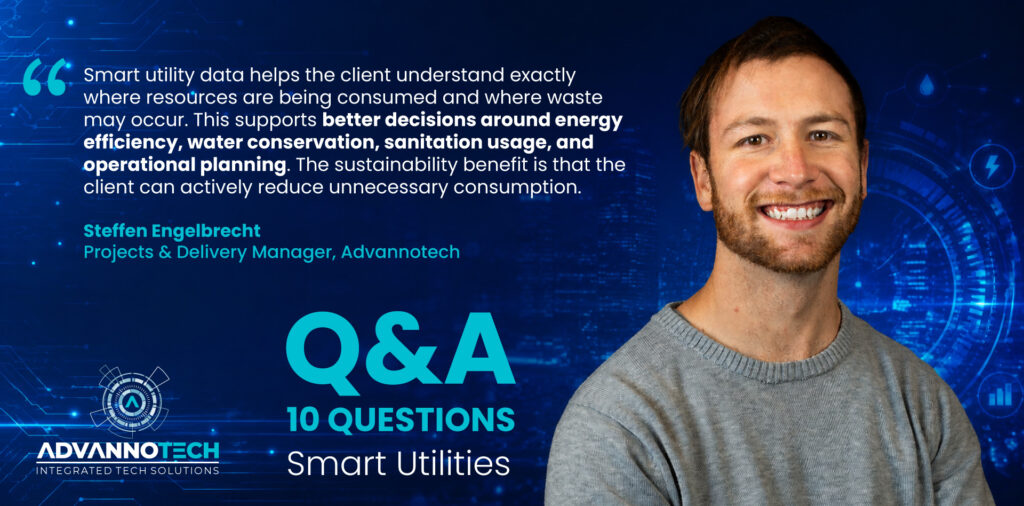
Smart utility data helps the client understand exactly where resources are being consumed and where waste may occur. This supports better decisions around energy efficiency, water conservation, sanitation usage, and operational planning. The sustainability benefit is that the client can actively reduce unnecessary consumption. The financial benefit is that reduced waste directly improves operating costs. In simple terms, the same data that helps the client manage environmental performance also helps protect profitability.
Scalability is often overlooked when organizations invest in infrastructure. How important is it for smart utility solutions to be future-ready, and what opportunities does this unlock for businesses as they grow?
Scalability is very important because commercial properties do not stand still. Tenants change, tariffs change, municipal structures change, and owners may expand into additional buildings or sites. A future-ready utility platform allows the client to add more meters, more buildings, more utility types, and more tariff models without starting again from scratch. It also allows for more advanced use cases later, such as Time-of-Use optimization, tenant portals, owner reporting, ESG reporting, and integration into broader building management systems.
Looking ahead, how do you see intelligent utility management reshaping commercial buildings, estates, industrial facilities, and smart cities over the next few years and what role will data play in that transformation?
Utility management is moving away from manual meter reading and reactive billing. The future is live data, automated billing, configurable tariffs, exception alerts, and transparent reporting for owners, tenants, and operators. In commercial buildings, estates, industrial facilities, and smart cities, utilities will become part of the broader digital infrastructure. Data will help owners understand consumption, reduce waste, improve billing accuracy, manage tenants better, and make smarter investment decisions.
Advannotech’s role is to bring the technical layers together: meters, connectivity, cloud platforms, billing logic, dashboards, and operational workflows into one
working solution.
Interested in a similar solution for your utilities usage? Mail us: info@advannotech.co.za